Food-Grade Catalase for Hydrogen Peroxide Decomposition Enzyme
For Gluconate / Gluconic Acid Salt Production & Food Processing Applications
Product Overview
Food-grade Catalase is a high-activity enzyme produced via submerged fermentation of Aspergillus niger. It rapidly degrades hydrogen peroxide (H₂O₂) into water and oxygen and is widely used in the production of sodium gluconate, gluconic acid, glucono-delta-lactone (GDL), and in various food and beverage processing applications where peroxide removal is required.This liquid catalase ensures efficient oxidative-residue removal, supporting cleaner, milder downstream processing conditions. It is ideal for manufacturers who require strict control of peroxide levels to ensure high product quality and safety.
Key Features & Benefits
- High catalytic efficiency: Rapidly decomposes hydrogen peroxide after sterilization or oxidation steps.
- Clean and safe reaction: Produces only water and oxygen—no unwanted by-products.
- Broad temperature adaptability: Optimal working temperature is 40–55°C.
- Optimal pH range: Performs best within pH 6.0–9.0.
- Easy formulation compatibility: Liquid form ensures fast dispersion and integration into diverse systems.
- Supports food-grade applications: Suitable for food, beverage, fermentation, dairy, and nutraceutical processing.
Typical Applications
- Sodium gluconate production
- Gluconic acid and gluconate derivative manufacturing
- Dairy processing (e.g., cheese production)
- Beverage processing (juices, functional drinks)
- Snack food processing
- Nutritional supplements and tablet production
Recommended Usage & Dosage
Catalase is used after the oxidation stage to eliminate residual hydrogen peroxide.
Dosage varies depending on peroxide concentration, temperature, and system mixing efficiency.
| Application | Dosage Range | Typical Addition per Metric Ton |
|---|---|---|
| Sodium gluconate | 0.2–0.5% | 2–5 kg enzyme per ton |
| Gluconic acid fermentation | 0.6–1.2% | 6–12 kg enzyme per ton |
| Gluconate derivatives | 0.6–1.5% | 6–15 kg enzyme per ton |
Pilot testing is recommended to determine optimal dosage for each production system.
Mode of Action
Catalase accelerates the redox decomposition of hydrogen peroxide, converting it into harmless components:
2H₂O₂ → 2H₂O + O₂↑The enzyme binds hydrogen peroxide molecules and rapidly breaks them down into water and oxygen, offering a highly efficient and biologically safe method for peroxide removal.
Process Workflow
In sodium gluconate enzymatic production, catalase is added after the oxidation step to remove residual hydrogen peroxide before neutralization. The general workflow includes glucose dissolution, formulation, enzymatic oxidation, catalase treatment, neutralization, filtration, optional decolorization, concentration, crystallization, drying, and final packaging. Catalase ensures that no peroxide residues enter downstream purification or crystallization steps, improving overall product purity and stability.
Specifications
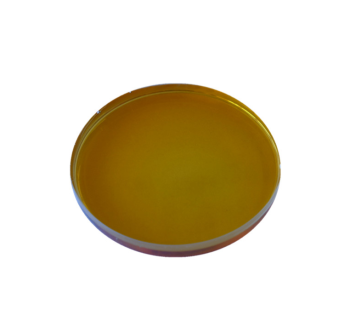
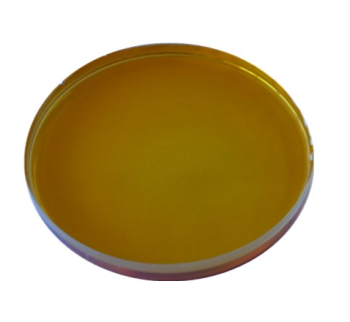
- Appearance: Dark-brown liquid
- Activity: High-efficiency, food-grade catalase
- Source: Fermentation of Aspergillus niger
- Optimal temperature: 40–55°C
- Optimal pH: 6.0–9.0
- Typical dosage: 2–15 kg per metric ton of material
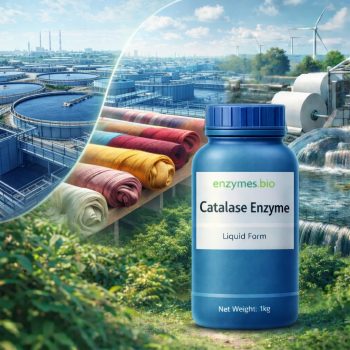
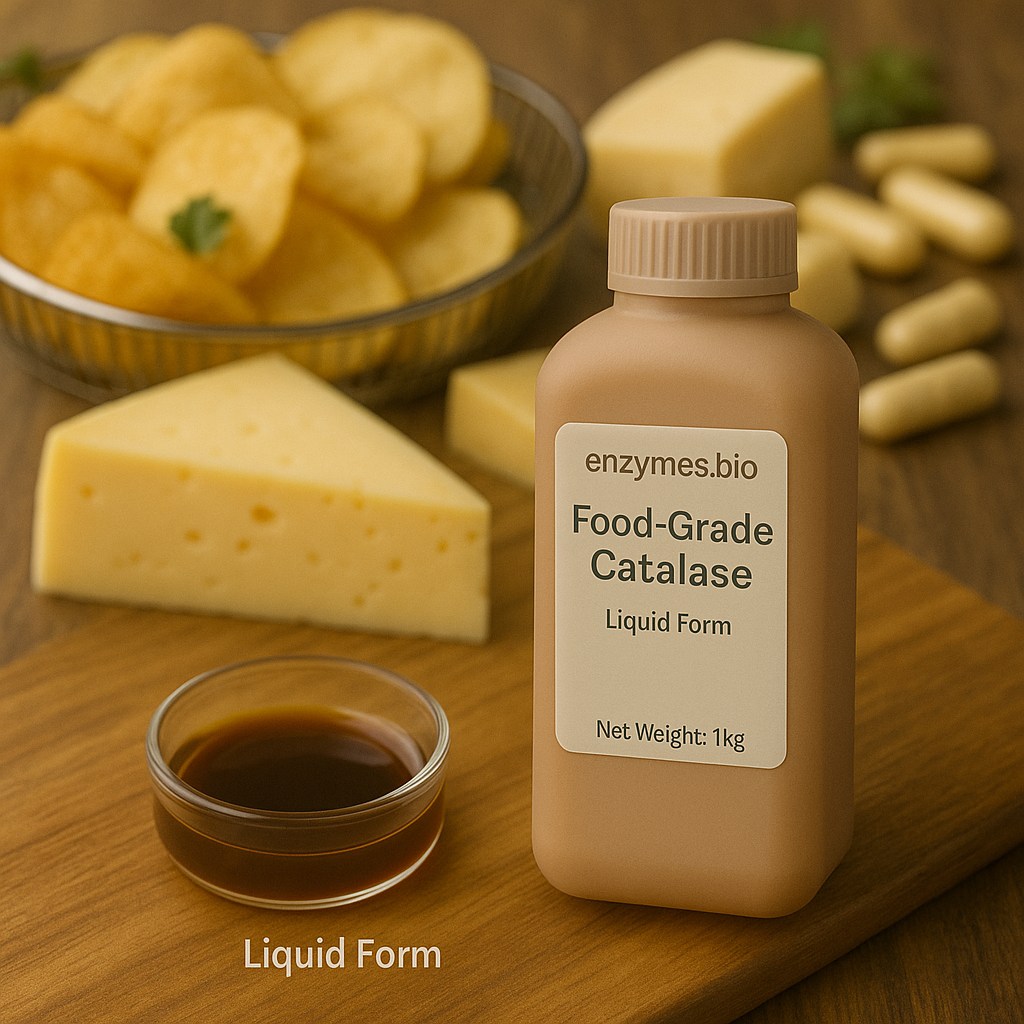
- Packaging: 1 kg bottle (supplied in an industrial-grade plain bottle). Please note that the product image is for illustration purposes. Actual packaging may differ.
- Shelf life: 12 months under recommended storage conditions
Storage Recommendations
Store in a cool, dry environment away from direct sunlight. Keep the container sealed when not in use to maintain enzyme activity. Avoid exposure to high temperatures or extreme pH conditions.