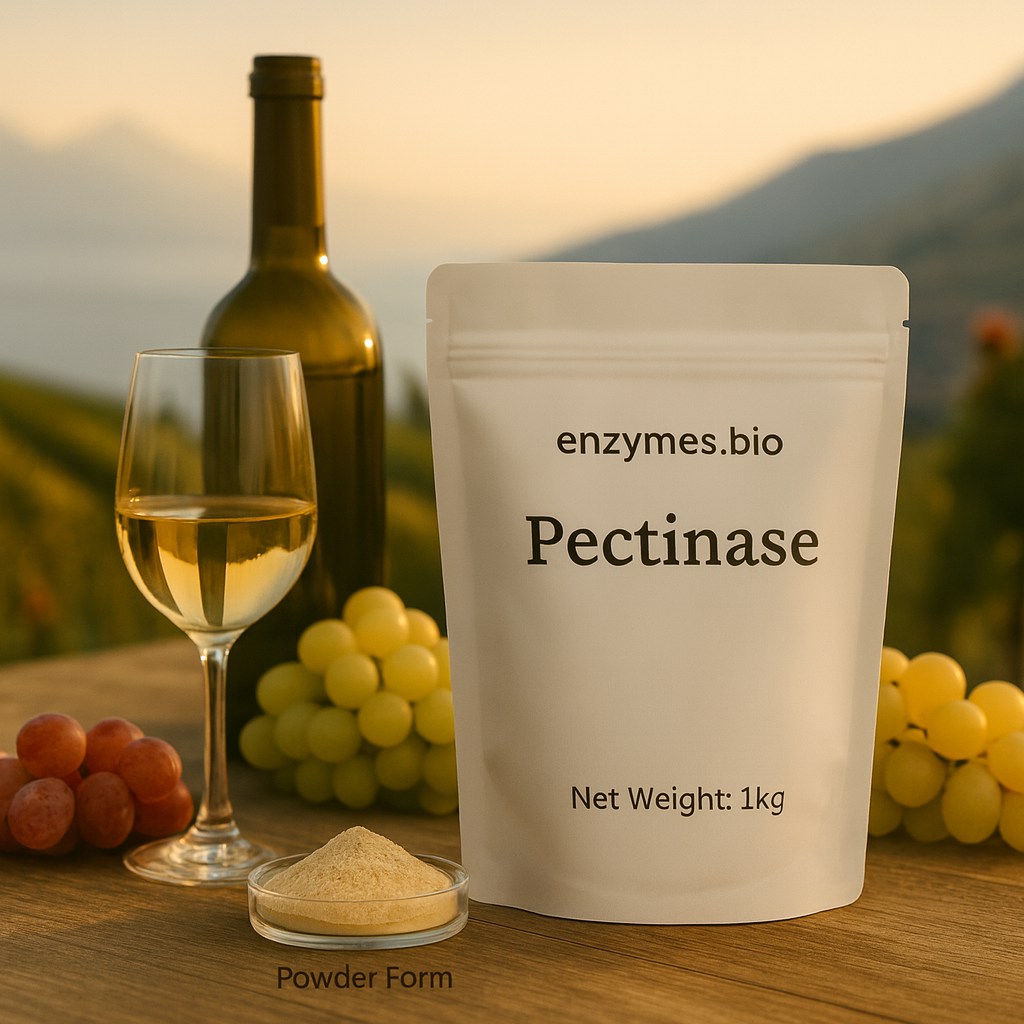
Food-Grade Pectinase for White Wine Production
This food-grade pectinase is a highly active enzyme designed for white grape processing and white wine production. It breaks down natural pectin in grape skins and juice, improving juice yield, accelerating clarification, and enhancing filtration efficiency. Supplied as a light yellow to beige free-flowing powder, it is suitable for wineries, craft winemakers, and fruit-processing facilities.
Ingredients
Main enzyme: Pectinase
Auxiliary ingredient: Maltodextrin
Key Benefits
- Higher juice yield – Hydrolyzes pectin in grape cell walls, releasing bound juice and improving pressing efficiency.
- Faster clarification – Reduces viscosity, promotes sedimentation, and shortens settling time before fermentation.
- Improved aroma expression – Helps release aroma precursors for cleaner, fresher white wine flavor profiles.
- Stable performance – Active across a broad temperature range commonly used in winemaking.
- Versatile applications – Effective for must treatment, clarification, and other pectin-rich fruit processing.
Typical Applications
- White grape crushing & pressing – Add directly to crushed grapes or presses to enhance juice extraction.
- Must clarification – Apply to freshly pressed juice to accelerate settling and prepare clear must for fermentation.
- Juice pre-treatment – Reduce turbidity and viscosity for easier filtration or concentration.
- Other fruit wines & juices – Suitable for apple, pear, berry, and other pectin-rich fruits.
Recommended Dosage
- White grape mash: 20–30 g/ton
- Juice pre-treatment: 10–30 g/ton
- Other fruits: Adjust based on small-scale trials
For best results, perform bench trials to determine optimal dosage.
Recommended Operating Conditions
- Temperature: 15–63°C
- pH: 3.5–5.5
- Contact time: Minimum 1 hour; longer contact generally improves effectiveness.
Directions for Use
- Dissolve the required amount of pectinase in a small amount of clean water.
- Add evenly into grape mash or juice while mixing thoroughly.
- Maintain the recommended temperature and pH range during the reaction.
- Proceed with pressing, clarification, racking, or filtration after adequate reaction time.
Technical Notes
- Performance depends on temperature, pH, and reaction time. Longer reaction time is beneficial within the working range.
- Normal SO₂ levels used in winemaking do not significantly inhibit enzyme activity.
- Do not add bentonite before the enzymatic reaction is complete, as bentonite can deactivate enzymes.
- Pre-dissolving the enzyme in water improves uniform distribution in must or juice.
Additional Notes
- The recommended dosage assumes ≈15°C operation; activity increases with temperature within 15–63°C.
- Contact time should not be less than 1 hour; longer contact improves results.
- Normal wine alcohol levels (<16% v/v) and standard SO₂ usage do not reduce activity.
- Dissolve the enzyme in a small amount of pure water before application for better dispersion.
Typical Specifications
| Property | Typical Value |
|---|---|
| Appearance | Light yellow to beige powder |
| Activity | 4,500 U/g food-grade pectinase |
| Density | Approx. 0.8–1.1 g/mL (bulk density) |
| pH (25 °C) | 4.0–5.0 |
| Working pH | 3.5–5.5 |
| Optimal Temp | 45–55 °C (activity still effective from 15–63 °C) |
| Formulation | Pectinase enzyme with maltodextrin carrier |
Packaging
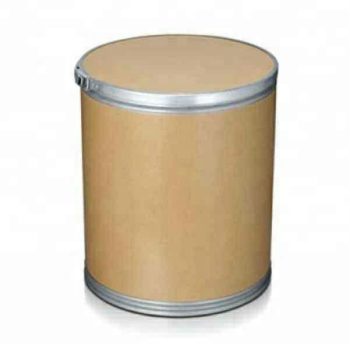
1 kg/bag (aluminum foil pouch; please note that the product image is for illustration purposes and actual packaging may differ).
Storage & Shelf Life
- Store in a cool, dry place away from sunlight and moisture.
- Seal tightly after opening to prevent humidity-related activity loss.
- Stable for the stated shelf life under recommended storage conditions.
Handling & Safety
- Avoid inhalation of enzyme dust and avoid eye or prolonged skin contact.
- Wear gloves, protective clothing, and eye protection when handling in bulk.
- Rinse with plenty of water if contact occurs; seek medical advice if irritation persists.
- Use in accordance with food safety regulations and good manufacturing practices.